China’s DIY craft toy sector is moving from simple coloring kits toward creative, educational, and customizable play. Global buyers increasingly seek products that combine imagination, fine-motor practice, and screen-free engagement. The key question is: what are the latest trends in DIY craft toys?
Grand View Research valued the global arts and crafts market at approximately USD 44.12 billion in 2023. Its forecast also indicates strong growth through 2030. This broader category includes materials and activities that influence craft-toy development. The Toy Association’s industry trend reports highlight creative play, STEM learning, personalization, and family participation as important purchasing drivers. These signals support demand for jewelry-making sets, recycled-material kits, miniature room projects, and beginner-friendly science crafts.
Richard Gottlieb, CEO of Global Toy Experts, often states, “The toy industry is not about toys. It’s about play.” His view helps explain why successful DIY products need more than attractive packaging. They should offer a clear challenge, satisfying results, and room for personal expression. A child mixing colors, threading wooden beads, or building a paper model creates visible evidence of engagement.
China remains a major production base because suppliers can combine mold development, printing, packaging, and small-batch customization. However, low price alone is becoming a weak strategy. Buyers should examine material quality, age grading, instructions, and applicable requirements such as ASTM F963, CPSIA, or EN71. The market is not perfectly tidy. Some “eco-friendly” claims still lack strong verification. Careful buyers should request test reports and inspect samples before scaling orders.
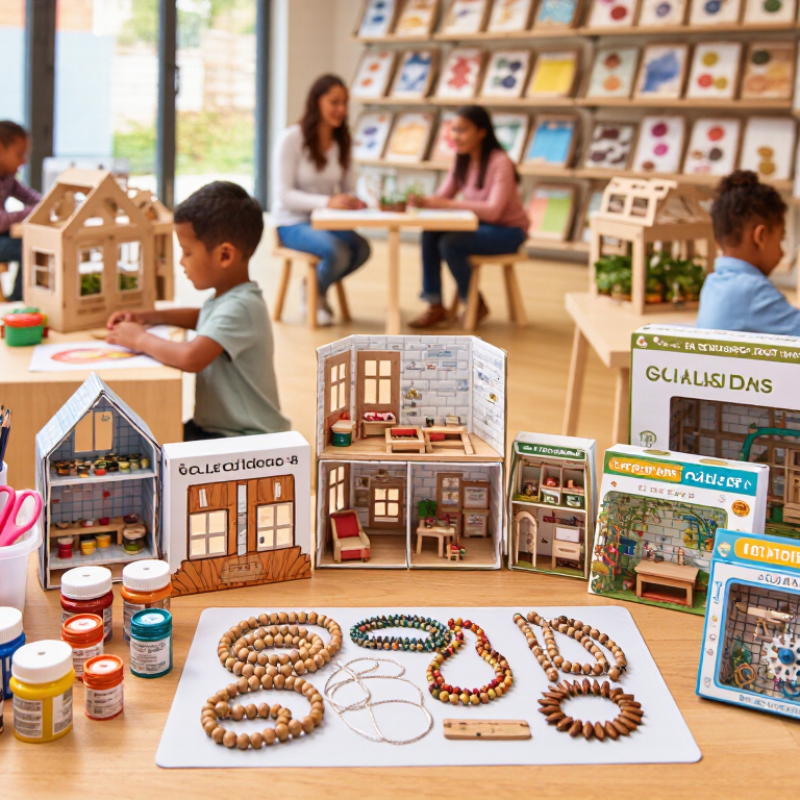
China’s DIY craft toy market is defined by flexible production, fast sampling, and strong material access. According to UN Comtrade 2023 data, China remained the leading exporter under HS 9503, covering many toy categories. This scale supports smaller trial orders and frequent design updates for global buyers.
Market direction is also changing. Circana’s 2024 toy industry reporting showed continued pressure on discretionary spending in several major markets. Buyers therefore seek kits with clear play value, not only attractive packaging. Research and Markets forecasts steady growth for the global arts and crafts toy sector through the decade, driven by screen-free activities and parent-child learning. Chinese suppliers respond with paper craft, clay modeling, bead design, and beginner sewing formats. Some kits still look interchangeable. That weakness deserves attention.
Reliable sourcing requires more than factory photos. Buyers should inspect material thickness, color stability, tool safety, instruction clarity, and age grading. They should also request batch samples before confirming production. Compliance with applicable standards, such as EN 71 or ASTM F963, must be verified for each destination. A practical sample should survive repeated handling without loose parts, sharp edges, or confusing steps. That matters.
From factory visits and sample reviews, the strongest products usually combine simple entry steps with room for personal expression. However, “educational” claims can become vague. Buyers should ask for evidence, testing records, and user feedback instead of accepting broad promises.
Chinese manufacturers are reshaping DIY craft toys through compact, skill-based kits. Grand View Research estimates the global arts and crafts market reached about USD 44 billion in 2023, with steady growth expected through 2030. This demand supports smaller projects, including clay charms, paper engineering, bead designs, and beginner embroidery. Many factories now offer modular parts, clearer visual instructions, and color-coded tools for children and family users.
Personalization is becoming a strong purchasing factor. Buyers can request themed components, adjustable difficulty, and packaging for different age groups. Digital instruction cards are also common, using QR codes for short assembly videos. Safety remains practical, not decorative. Manufacturers increasingly document material testing, small-part warnings, age grading, and traceability. The 2024 global toy safety testing guidance continues to emphasize mechanical, chemical, and flammability controls.
Sustainability is influencing product development, although progress is uneven. PwC’s 2024 Voice of the Consumer Survey found that 46% of consumers would pay more for sustainably produced goods. Chinese suppliers are responding with paper-based trays, reduced plastic windows, and water-based finishes. Some changes still feel superficial. A recycled box cannot offset excessive inner packaging. Global buyers should check test reports, material declarations, sample consistency, and factory quality records before placing large orders. Data definitions differ between reports, so market figures require careful comparison.
The chart shows a normalized trend index for major DIY craft toy directions emerging from Chinese manufacturing supply chains, with 2021 set as the baseline of 100.
Eco-friendly materials, STEM-focused activities, customization, and screen-free family play are gaining momentum among international buyers. The index is intended for trend comparison rather than sales measurement.
China’s craft toy market is moving toward tactile, screen-free play. Paper kits, unfinished wood sets, felt pieces, and water-based modeling materials are popular with global buyers. In my sourcing experience, material consistency matters more than flashy packaging. Smooth edges, stable pigments, and clean cutting improve both safety and play value. Recycled paper is gaining attention, although its surface can sometimes weaken after folding.
Designs now favor modular scenes, miniature architecture, nature themes, and open-ended storytelling. Buyers often request fewer fixed steps and more creative choices. Common production skills include die-cutting, wood shaping, stitching, hand painting, and small-part assembly. Skilled suppliers combine these methods carefully. A beautiful prototype can still fail if pieces fit poorly. That remains an important lesson. Reliable suppliers should provide material details, age guidance, sample approvals, and testing documents for the intended markets.
Tips: Request two physical samples, not one. Test folding, painting, and repeated assembly yourself. Check whether instructions use clear images and simple language. Ask how suppliers control dust, sharp edges, and color variation. Compare the finished unit cost with the labor required at home. Some kits look inexpensive, but complicated assembly may reduce customer satisfaction. Also, review packaging durability before shipping; thin cartons can crush delicate components.
For global buyers, China’s DIY craft toy market offers colorful kits, modular parts, and strong customization. Quality evaluation should begin with the actual product, not only supplier photos. Check cutting edges, small components, surface coatings, thread strength, and instruction clarity. A good kit should feel consistent across several samples.
Safety testing must match the destination market and the toy’s age grade. Review reports for mechanical hazards, flammability, heavy metals, harmful chemicals, and small-part risks. Materials such as paint, glue, foam, and plastic need traceable specifications. Ask for batch records, test dates, laboratory details, and corrective-action reports. Compliance documents should reflect the exact product, not a similar model.
Packaging also deserves close inspection. Labels should show age guidance, warnings, material information, and importer details where required. Cartons need moisture protection, secure inner packing, and readable product codes. Factory audits can reveal poor storage, mixed batches, or weak inspection routines. Still, no checklist is perfect. A sample may pass testing while production changes later. Keep approval samples, arrange pre-shipment inspections, and review complaints after delivery. That ongoing discipline is often more reliable than one impressive certificate.
| Evaluation Dimension | Latest Buyer Trend | Recommended Product Evidence | Key Export-Market Requirement | Practical Quality or Safety Check | Priority | Typical Risk if Missing |
|---|---|---|---|---|---|---|
| Age Grading and Intended Use | Clear age segmentation, especially for preschool, school-age, and family craft kits. | Age-grade rationale, product specification, warnings, and supervised-use instructions. | Age grading must reflect product complexity, foreseeable use, and small-part hazards. | Review component size, activity difficulty, sharp edges, cords, magnets, and required supervision. | High | Incorrect age classification, injury risk, product recall, or customs and marketplace rejection. |
| Mechanical and Physical Safety | Durable, reusable kits designed for repeated creative play rather than one-time use. | Batch inspection records, material specifications, assembly instructions, and laboratory test reports. | Relevant toy-safety requirements may include EN 71, ASTM F963, ISO 8124, or destination-country rules. | Check pull strength, torque, drop resistance, seams, fasteners, points, edges, and detachable parts. | Required | Loose parts, choking hazards, cuts, breakage during normal play, or nonconformity findings. |
| Small Parts and Choking Prevention | More kits include beads, buttons, sequins, clips, and mini construction pieces. | Small-parts assessment, component inventory, age warning, and packaging-control records. | For the United States, small-parts rules and applicable ASTM F963 requirements are relevant; other markets have comparable provisions. | Use an approved small-parts cylinder or equivalent market-specific method and inspect every component type. | Required | Serious child-safety incident, mandatory corrective action, or shipment detention. |
| Chemical Safety | Growing preference for water-based, low-odor, non-toxic paints, glues, clays, and recycled materials. | Bill of materials, supplier declarations, safety data where applicable, and accredited laboratory reports. | EU products may require EN 71-3 chemical migration testing and REACH compliance; U.S. products may require CPSIA and applicable ASTM testing. | Test paints, coatings, plastics, textiles, modeling compounds, adhesives, and printed surfaces separately where necessary. | Required | Restricted-substance violation, failed testing, consumer exposure, or import prohibition. |
| Lead and Phthalates | Buyers increasingly request substance declarations for every color, coating, and soft-plastic component. | Material-level test reports and controlled supplier documentation. | U.S. CPSIA limits total lead in accessible toy components to 100 ppm and restricts specified phthalates to 0.1% for covered products. | Verify current legal scope, test representative colors and formulations, and control recycled-content inputs. | Required | Legal noncompliance, product withdrawal, penalties, and loss of buyer confidence. |
| Magnets and Magnetic Components | Magnetic tiles, craft closures, and buildable accessories remain attractive but require strict controls. | Magnet inventory, magnetic flux or strength assessment, retention testing, and warning review. | Markets such as the United States apply specific requirements to hazardous high-powered magnets and toys containing magnets. | Check whether magnets can detach, whether they can be swallowed, and whether the product is correctly age-graded. | Required | Severe internal-injury risk, recall exposure, and serious regulatory action. |
| Paints, Markers, and Adhesives | Non-toxic creative consumables, washable colors, and refillable components are valued by parents and schools. | Formula control, batch numbers, shelf-life information, ingredient or compliance declaration, and usage instructions. | Requirements vary by destination and by whether the item is classified as a toy, art material, cosmetic-like product, or chemical mixture. | Check odor, leakage, drying performance, skin-contact instructions, cap security, and contamination controls. | High | Allergic reaction, leakage, poor user experience, or classification-related compliance failure. |
| Electrical and Battery Safety | DIY kits increasingly add LEDs, sound modules, motors, or simple coding functions. | Electrical schematic, battery specification, insulation checks, abuse testing, and battery-compartment design records. | Use the applicable toy, electrical, battery, and button-cell requirements for the destination market. | Check short-circuit protection, overheating, polarity, battery retention, accessible button cells, and charger compatibility. | Required | Burn, fire, ingestion, leakage, electromagnetic, or transportation-related safety risk. |
| Textiles, Fibers, and Sewing Materials | Embroidery, weaving, felt, fabric painting, and recycled-fiber projects are popular screen-free activities. | Fiber composition, colorfastness, seam-strength records, flammability assessment, and supplier traceability. | Applicable toy, textile-labeling, flammability, and chemical requirements depend on the destination and product function. | Inspect loose fibers, needle security, thread strength, fraying, color transfer, and sharp accessory parts. | High | Skin irritation, flammability concern, choking hazard, labeling failure, or premature product damage. |
| Packaging and Instruction Quality | Compact packaging, reduced plastic, multilingual instructions, and QR-linked tutorials are increasingly requested. | Packaging artwork approval, multilingual manual, warning review, QR-code validation, and carton specifications. | Warnings, instructions, importer information, age marking, and traceability details must match the destination market. | Verify readable font size, language accuracy, durable printing, barcode quality, and safe opening features. | High | Misuse, missing warnings, marketplace delisting, customs delays, or poor customer reviews. |
| Sustainability and Materials Transparency | Recycled paper, FSC-certified paper where applicable, bio-based materials, refill packs, and plastic reduction. | Material origin statement, recycled-content evidence, packaging weight data, and disposal guidance. | Environmental claims should be specific, substantiated, and consistent with the destination market’s advertising rules. | Confirm recycled-content claims, avoid vague “eco-friendly” wording, and check material consistency across batches. | Medium | Greenwashing allegations, buyer claim disputes, inconsistent quality, or restricted-market labeling issues. |
| Traceability and Batch Control | Retailers and distributors prefer products that can be traced to a production batch and component source. | Factory code, production date, lot number, bill of materials, inspection record, and retained samples. | Many toy frameworks require or expect economic-operator information and product traceability documentation. | Match carton, product, manual, and test-report identifiers; retain samples for each significant formulation change. | Required | Slow investigation, ineffective recall, inability to prove conformity, or shipment dispute. |
| Quality Consistency and AQL Inspection | Global buyers are shifting from sample approval alone to repeatable pre-shipment and in-line controls. | Approved golden sample, inspection checklist, defect classification, corrective-action record, and final inspection report. | Use a documented sampling plan, commonly based on ISO 2859-1 or an agreed buyer-specific standard. | Inspect appearance, quantity, function, accessories, packaging, labeling, and critical safety defects separately. | High | Mixed quality, high return rates, chargebacks, delivery delays, or rejected containers. |
| Laboratory Testing and Certification | Buyers favor independent testing from laboratories with relevant toy-safety competence and recognized accreditation. | Current test report, sample description, standards edition, laboratory scope, test date, and corrective-action history. | Testing does not replace legal responsibility; the required standards depend on product design and destination. | Confirm that the tested sample exactly matches the production version, materials, colors, packaging, and instructions. | Required | Invalid evidence, repeated testing costs, border issues, or failed retailer onboarding. |
| Market Documentation and Import Readiness | Importers increasingly request a complete digital compliance file before placing purchase orders. | Declaration of conformity where applicable, test reports, technical file, commercial invoice, packing list, and origin information. | Documentation, labeling, product registration, and importer obligations vary by market and product category. | Prepare a country-specific checklist and verify document consistency before production and shipment. | Required | Customs hold, retailer rejection, delayed launch, or inability to defend a compliance claim. |
| Product Differentiation and Learning Value | Open-ended STEM, maker, arts-and-crafts, sensory, and screen-free learning experiences are strong buyer interests. | Learning objectives, project outcomes, difficulty levels, refill options, and age-appropriate activity instructions. | Claims such as “educational,” “non-toxic,” or “sustainable” should be accurate and supportable. | Test whether children can complete the activities with the stated contents, time, tools, and skill level. | High | Misleading claims, low repeat purchase, poor reviews, and weak retail differentiation. |
| Export Readiness Score | Professional buyers prioritize documented risk control over the lowest unit price. | Completed compliance matrix, approved samples, test plan, production-control plan, and shipment-release checklist. | Recommended internal gate: no unresolved critical safety or legal issue before mass production. | Use a three-level decision: Pass, Corrective Action Required, or Hold Shipment. | High | Costly post-shipment correction, recall, reputational damage, or market-access failure. |
China’s DIY craft toy market is moving toward creative, screen-free activities with clear learning value. International buyers increasingly request paper kits, wooden sets, bead projects, and reusable modeling materials. In supplier reviews, I check material certificates, age guidance, tool safety, and production consistency. A colorful sample proves little if the adhesive dries poorly or small parts arrive mixed together. Small details matter.
Customization should begin with the target child, not only the logo or package color. Buyers can adjust themes, piece counts, instruction language, packaging size, and difficulty levels. Requesting a pre-production sample helps reveal weak folds, unclear diagrams, or unsuitable textures. It also exposes hidden costs, such as custom molds, printed inserts, and separate packaging assembly. A lower minimum order quantity may increase unit pricing.
Purchasing decisions should include factory capacity, inspection procedures, lead time, and shipping protection. Ask for batch photos and a written quality checklist. I once accepted attractive prototypes too quickly; the first mass-production batch had uneven cutting edges. That mistake taught me to inspect random cartons, not just one finished sample. Payment terms, replacement policies, and realistic delivery windows deserve equal attention. Cheap sourcing is not always efficient sourcing.
Flexible production supports small trial orders and frequent design changes. Sampling is often fast. Suppliers can offer paper crafts, clay projects, bead designs, and beginner sewing kits. However, some products still look too similar.
Compact, skill-based kits are increasingly popular. Examples include clay charms, paper engineering, bead designs, and beginner embroidery. Modular parts can make projects easier to adjust. Demand is also growing for screen-free family activities.
Inspect several samples, not just factory photographs. Check material thickness, cutting edges, surface coatings, thread strength, and loose parts. Tools should feel secure in small hands. The result should remain consistent across samples.
Request reports covering mechanical hazards, flammability, chemicals, heavy metals, and small parts. Confirm the documents match the exact product and age grade. Check test dates, laboratory details, material specifications, and batch records. One certificate is not enough.
Instructions should use clear steps, pictures, and color-coded tools. A short assembly video can help, especially for younger users. Ask for evidence behind educational claims, such as testing records or user feedback. “Educational” can be vague.
Packaging should show age guidance, warnings, material information, and required importer details. Cartons need moisture protection and secure inner packing. Readable product codes help trace batches after delivery. A recycled box alone does not prove sustainability.
Keep an approved sample for comparison. Arrange pre-shipment inspections before goods leave the factory. Review complaints, batch records, and corrective actions after delivery. Production can change later.
Yes, buyers can request themed components, adjustable difficulty, and age-specific packaging. They may also customize colors, modular parts, and instruction formats. Confirm every change through updated samples and written specifications. Customization still needs testing.
China’s DIY craft toy market is evolving through a combination of creative design, practical learning, and flexible manufacturing. For global buyers asking, “what are the latest trends in DIY craft toys,” key developments include eco-conscious materials, reusable components, modular kits, sensory activities, STEM-inspired projects, and customizable sets for different age groups. Chinese manufacturers are also improving visual design, packaging efficiency, and production flexibility to support private-label and small-batch purchasing needs.
When evaluating products, international buyers should examine material safety, durability, color stability, clear instructions, age suitability, and relevant testing documentation for their target markets. Common materials may include paper, wood, fabric, non-toxic plastics, and water-based adhesives, depending on the product design. Buyers should also confirm customization options, minimum order quantities, sample procedures, lead times, packaging requirements, and quality-control processes before placing an order. A reliable sourcing strategy balances creativity, safety, compliance, cost, and consistent production capacity.

JKit Toys