In 2026, families are looking beyond toys that simply entertain. DIY craft toys invite children to turn cardboard, yarn, paper, and safe, age-appropriate materials into something of their own. But what are the benefits of DIY craft toys for children? The answer is more than a finished paper puppet or painted box. Making and adjusting a project can give children practice with hand control, planning, patience, and creative problem-solving. A child threading chunky beads, for example, must coordinate both hands and decide what comes next.
Maria Montessori, physician and educator, wrote, “The hands are the instruments of man’s intelligence.” Her observation helps explain why hands-on play can matter: children explore ideas by touching, arranging, testing, and changing materials. Crafting can also create small opportunities for shared conversation. A caregiver might ask why a child chose blue paper, or how a loose wheel could be fixed. The child gets to explain, revise, and try again.
The results will vary. Some children love careful projects; others would rather build for three minutes and move on. That is normal. A craft does not need to look polished to be worthwhile. In this guide to the top benefits of DIY craft toys for children, we’ll look at how creative play may support development, confidence, and connection, while also considering realistic limits. Adult guidance, a suitable difficulty level, and safe materials matter. And yes, cleanup can be part of the experience.
What DIY Craft Toys Are and How Children Use Them
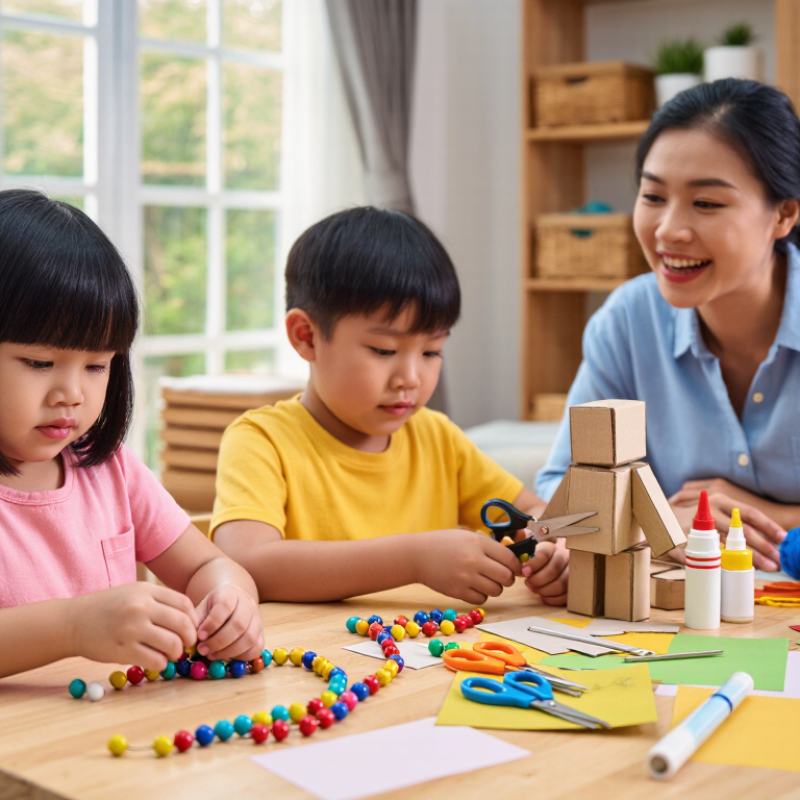
DIY craft toys are kits or loose materials that children turn into something they can use, display, or give away. They may include paper, child-safe scissors, washable paint, beads, or simple building pieces. Children can follow picture instructions, then change colors, shapes, or steps to suit their own ideas. A cardboard creature might gain uneven wings. That is part of the process.
While making, children practice pinching small pieces, measuring, sorting, and explaining their choices. A Harvard Center on the Developing Child resource, “Brain Architecture,” reports that more than one million neural connections form per second in the early years. This figure describes early brain development generally; it does not prove that craft kits alone create those connections. The American Academy of Pediatrics’ clinical report “The Power of Play” also discusses play’s role in language, social-emotional skills, and executive function. A craft activity can offer chances to practice these skills, especially when an adult asks open questions instead of fixing every mistake. Some kits are too difficult, and children may lose interest. Choose materials that fit the child’s age, supervise small parts, and leave room for a messy, imperfect result.
How Crafting Supports Fine Motor Skills and Hand-Eye Coordination
2026 Top Benefits of DIY Craft Toys for Children?
How Crafting Supports Fine Motor Skills and Hand-Eye Coordination
Crafting turns everyday play into useful hand practice. Children pinch paper scraps, squeeze soft clay, thread large beads, and snip paper with child-safe scissors. Each action asks fingers to work separately while eyes guide placement. Small movements matter. The CDC’s four-year milestone checklist notes that many children hold a crayon between their fingers and thumb, rather than in a fist. Simple crafts offer low-pressure chances to practise that grip, trace shapes, and coordinate both hands.
There is evidence beyond anecdote. A 2010 analysis in Developmental Psychology examined about 21,260 U.S. children in the Early Childhood Longitudinal Study–Kindergarten cohort. Fine-motor measures, including copying and drawing tasks, predicted later mathematics and reading performance. This does not prove that crafts alone improve achievement. It does support giving children regular chances to handle varied tools and materials. Practice, not perfection. A lopsided paper flower still involves aiming, adjusting, and trying again.
Tips: Offer thick crayons, blunt scissors, washable glue, and large beads suited to the child’s age. Start with tearing paper or rolling clay before introducing harder tasks. Keep sessions short, and watch for frustration. Model one step, then let small hands take over. Don’t correct every uneven cut. The work is the practice.
2026 Top Benefits of DIY Craft Toys for Children: How Crafting Supports Fine Motor Skills and Hand-Eye Coordination
Note: Craft activities provide opportunities to practice hand movements and visual guidance; they do not guarantee a specific developmental outcome. Children develop at different rates, so adapt the activity to each child’s abilities and supervise according to age and materials used.
How Open-Ended Projects Encourage Creativity and Problem-Solving
DIY craft toys work best when they leave room for children to decide what comes next.
A cardboard tube might become a telescope, a bridge, or nothing useful at all. That uncertainty is part of the work. Children test ideas, notice when a paper flap sags, then fold or tape it differently. There is no single correct answer.
The OECD’s PISA 2022 creative-thinking assessment covered 15-year-olds in 64 countries and economies. It measures creative thinking, not the effect of craft toys, so it should not be read as proof that one activity raises scores. Still, the assessment highlights a skill children can practise through open-ended making: generating and improving ideas. The American Academy of Pediatrics’ 2018 clinical report also describes play as a way to support learning and development.
Play matters.
A simple project can invite real problem-solving. Ask a child to build a paper tower that holds three buttons, then let them choose the shape and materials. If it falls, pause before fixing it. “What could change?” is often more useful than showing the answer. Some attempts will be messy. Adults may need to resist taking over, especially when the tape twists or the tower leans. Leave the crooked tower standing for a minute.
How Shared Craft Activities Build Communication and Cooperation
2026 Top Benefits of DIY Craft Toys for Children?
Shared craft activities turn communication into something children can practice with their hands. While making a paper town, one child might suggest a bridge, while another chooses where it should go. They learn to explain ideas, listen, and adjust plans together. Small disagreements are normal. They can also be useful when an adult helps children take turns speaking instead of choosing a winner. Cooperation takes practice.
Crafting gives children a shared goal, such as finishing a cardboard animal or stringing beads into a pattern. Children can divide simple tasks, ask for help, and notice how each person’s contribution matters. Adults can support this by asking open questions: “What could we try next?” or “How can we make room for both ideas?” Avoid correcting every uneven cut; children need space to solve manageable problems. Some projects may still end in frustration, and that is worth reflecting on rather than hiding.
Tips: Choose materials suited to the children’s ages, prepare a clear workspace, and offer a few choices instead of a fixed design. Use phrases like “Your turn to share” and “Let’s decide together.” Keep the project short enough to finish before attention fades.
How Shared Craft Activities Build Communication and Cooperation
Selected CDC social milestones that children can practice during shared, age-appropriate activities.
Why it matters: Taking turns, sharing materials, and talking through a project give children opportunities to practice social skills. These milestones describe typical development; the chart does not show that crafts cause children to reach them.
Source: CDC, Developmental Milestones. Ages shown are the ages at which CDC lists each selected milestone.
How Making Toys Can Foster Confidence and Emotional Growth
2026 Top Benefits of DIY Craft Toys for Children?
How Making Toys Can Foster Confidence and Emotional Growth
A child who turns a cardboard tube into a telescope is doing more than crafting. They choose an idea, test it, and adjust when the paper slips. Each small decision offers practice in agency:
“I made this, and I can change it.”
Small wins matter. A handmade toy also gives children a safe way to express feelings, especially when they invent characters or act out a difficult moment. Adults can support the process with calm questions, rather than correcting every uneven cut or lopsided wheel.
The OECD’s 2019 Survey of Social and Emotional Skills gathered responses from nearly 60,000 students across 10 cities. Its findings connect skills such as persistence and curiosity with children’s well-being and school outcomes. The American Academy of Pediatrics’ 2018 clinical report, “The Power of Play,” likewise describes play as valuable for social-emotional development. These reports support the value of play, but they do not prove that homemade toys alone build confidence. Keep expectations realistic. A child may feel proud today and frustrated tomorrow. Offer safe, age-appropriate materials, let them make manageable choices, and praise effort without pretending every project works. Sometimes the glue fails. That is useful, too. A brief pause, a fresh plan, and another attempt can help children notice their own growing resilience.
Conclusion
DIY craft toys give children the chance to turn simple materials and their own ideas into playthings they can use and enjoy. What are the benefits of DIY craft toys for children? The process can strengthen fine motor skills and hand-eye coordination as children cut, fold, shape, and assemble pieces. Because projects can be adapted in many ways, children also practice creativity and problem-solving, making choices and finding solutions when their plans change.
Crafting together can create opportunities for children to share ideas, listen, take turns, and cooperate. Completing a project, especially after working through a challenge, can help children feel proud of their effort and more confident in their abilities. These activities may also support emotional growth by giving children a relaxed way to express themselves. Overall, DIY craft toys combine hands-on play with learning, connection, and a satisfying sense of achievement.

 JKit Toys